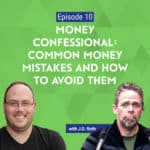
Money Confessional: Common Money Mistakes and How To Avoid Them, with J.D. Roth
Welcome to The MapleMoney Show, the podcast that helps Canadians improve their personal finances to create lasting financial freedom. I’m your host, Tom Drake, the founder of MapleMoney, where I’ve been writing about all things related to personal finance since 2009.
My guest this week is J.D. Roth, whose website, Get Rich Slowly, became one of the first ever personal finance blogs when he launched it in 2006.
In this episode, J.D. takes us through several mistakes he’s made with money over the years and shares many of the lessons he’s learned along the way. These days, he spends his time helping others develop healthy relationships with money.
J.D. and I cover lots of ground, as we discuss the perils of credit card debt, the dangers of trying to ‘win the lottery’ with high-risk stock investments, and the biggest money mistake that most people make.
Speaking of mistakes, J.D. explains that he once managed to spend $1500 on a frisbee!
Our sponsor this week is Wealthsimple. Put your money to work in a super smart, low maintenance, low fee portfolio, and watch it grow. Maple Money listeners get their first $10,000 managed free of charge for one year. For more on Wealthsimple, check them out here.
Episode Summary
- J.D. Roth shares his first ever money mistake.
- How J.D.’s upbringing influenced his relationship with money.
- Be careful that you’re not spending money for things you don’t use.
- J.D. shares the key to eliminating his debt in 39 months.
- Why you should avoid looking for quick ways to get rich.
- The current investment that is making J.D. nervous.
- The biggest money mistake that people make.
- The importance of creating a financial plan that will help you reach your goals.
Welcome to the Maple Money Show, the podcast that helps Canadians improve their personal finances to create lasting financial freedom.
On today’s show we’ll have a bit of fun by going through all the money mistakes J.D. Roth has made over the years. Roth was one of the very first personal finance bloggers when he started togetrichslowly.org. Now, there’s a point to his confessional. We’re going to show you common money mistakes and how you can make sure you take the right steps to avoid them.
Get rich slow with our sponsor, Wealthsimple. Put your money to work in a super-smart, low maintenance low-fee portfolio and watch it grow. Maple Money listeners get their first $10,000 managed for free for one year by visiting maplemoney.com/wealthsimple. Now here’s J.D….
Tom: Hi J.D., welcome to the Maple Money Show.
J.D.: Good to be here.
Tom: I wanted to have a show on money mistakes and thought who might be the person who is the absolute worst with money? So, I figured my good friend J.D. would be perfect to have on.
J.D.: That’s right. I’ve done a lot of dumb things in the past and I still do.
Tom: Yeah, I’ve admitted to a couple already on the podcast too, but today it’s your turn.
J.D.: I’m here to help.
Tom: Thanks for coming on. We’ll have some fun here. For those watching on video they’ll notice that you don’t look dressed right now and that’s because you’re sitting in the hot-tub as you record this. On audio, maybe no one will notice other than me just calling it out.
J.D.: I could splash and then your listeners would know.
Tom: Let’s just hop right into it, what are some of the first money mistakes you ever made?
J.D.: Oh boy, the first money mistake I made? I don’t know. I can remember making some as a kid, there’s no question. I think the first money mistake I made it was a life of crime. I’m trying to think of how old I was. When I was young I liked comic books. I’ve always been a nerd. I still like comic books but I didn’t have much money back then. This is when I was about eight, nine or ten years old. I learned that dad (when he got home from work) would empty his change and set it on one of the shelves in the bedroom. I’ve never told the story in public before. He put his change on one shelf in the bedroom and I learned I could go take 25 or 50 cents and he would never know because he’s not counting his change. Then I got bold and started taking $1 bills and then $5 bills. Eventually he caught on, realizing money was disappearing. He searched my bedroom and sure enough he found where I was stashing the money I was taking from him because he had put mark on the bills so he could figure out who had them. That was a mistake. I was turning to a life of crime instead of volunteering to do chores to make money. I was stealing money for my comic books. Did you ever do anything like this when you were a kid?
Tom: Yeah, that concerns me a bit because my two boys would say, “Oh, there’s some money there.” They definitely notice when there’s money lying on the counter.
J.D.: But for me, my family didn’t have a lot of money when I was growing up. My parents were pretty poor. I grew up in a beat up trailer house. My dad was unemployed a lot of times and they didn’t know how to handle money themselves so when they did have money a lot of times they would waste that money. All of a sudden they might have a windfall and have a few thousand dollars. Well, they would go out and spend that immediately on something instead of saving it. I learned that kind of behavior from them. I call this a “financial blueprint,” essentially, when you learn different financial behaviors from your parents or from your friends. You model what you see. That’s not to excuse the behavior but it explains where that comes from. Because I had watched my parents mismanage money, I made all sorts of similar money mistakes because I was doing what they had taught me to do. They were never careful about making sure they were getting the best deals or anything. They just spent the money. One of the earliest mistakes I can remember making—and it didn’t seem like a mistake at the time because a lot of times mistakes don’t seem like mistakes. I left home and went to college. The very first day of college as you’re signing up for classes there’s all sorts of these other booths set up in the auditorium (or at least that’s where it was in my school). And these booths offered things like credit cards or car insurance for college kids or bank accounts. And I didn’t have a bank account when I went to college so I needed to set one up. There were two different booths for banks in the gym. One of them was a big national bank and they were giving away a free Frisbee if you set up your checking account. And the other one was just a local credit union that wasn’t giving you anything. Well, as a college kid, which one are you going to pick? You’re going to go for that free Frisbee, right? That’s what I did anyway.
Tom: For sure.
J.D.: The credit union account gave free checking. The big national bank that I went with had $5 a month checking. That information was out there. It was available, but I just didn’t care. All I cared about was the free Frisbee. So I signed up with the big national bank and had that account for about 15 to 18 years. Eventually, the monthly fee was increased to $8 a month. I’m sure it’s $10 or $12 now if I’d stayed with them. But, by the time I left that bank, I calculated that I had paid over $1,500 in monthly fees just for the privilege of having a checking account—
Tom: And a Frisbee.
J.D.: I wanted the Frisbee! That’s what it was, this free Frisbee which was not free at all. It was a $1,500 Frisbee.
Tom: Wow. The first thing I thought was you were already at a net loss in the first month of a loan of $1,500.
J.D.: Yeah, that’s very indicative of that kind of stuff I used to do and I think a lot of people do. It’s easy to miss the big picture because you’re focusing on a small thing like a free Frisbee. You don’t think of what it’s going to add up to over time.
Tom: Yeah, there are two credit cards I signed up for in college. One was the credit card that just simply had the picture of my college on it. There was nothing extra with it but that just seemed like the card you’re supposed to get. I did end up getting that one. The one they didn’t even send me a card for was—I actually signed up for one just because I got a free Oilers t-shirt for filling out the application. But I never heard from them again so they probably saw how well I was doing with the college credit card and just figured I didn’t need the second one.
J.D.: That reminds me though, I’m sitting here thinking do I have any— I don’t want to call them zombie accounts because I used that checking account so it wasn’t necessarily a zombie account. But, do I have any accounts right now where I’m paying money that I shouldn’t be? And I realize that I do. I have one credit card I signed up for in 2011 because it offered me 100,000 bonus air miles for signing up. That was a huge, huge amount so I signed up for that. It has a $75 annual fee. I don’t actually use that account and I’m still paying that $75 annual fee. I used to use it, but I don’t anymore so I need to close that.
Tom: Yeah. Yeah for sure, that’s a good point about the fees because I’ve had that before too, and with other things as well. Sometimes you’re paying for things you don’t use. Before I cut the cord on cable—I don’t think we turned it on in two or three months before we really caught onto why we were paying for it. So we canceled it right away.
J.D.: But how do you watch your hockey games without cable?
Tom: I try to go to the games as often as I can. It’s harder now being an Edmonton Oilers fan, now that I moved down to just outside of Calgary. I see a lot less games but I’m pretty busy anyway. What’s your next big mistake?
J.D.: Well let’s think. I have certain go-to mistakes I talk about. Some of the things I’ve done are just so dumb. I guess another example I would use is my father was sick for a long time. He had cancer for a long time. He had never taken out life insurance when he was younger because, number one, he couldn’t afford it. Number two, he didn’t plan for any of this. He died in 1995 of this cancer. A couple of years before that he took out a very small policy because nobody was going to issue a policy on him when he knew he had cancer. But somebody gave a small policy and that meant that I got $5,000 in life insurance money when he died. At that time, I already had over $20,000 in credit card debt. If you get a $5,000 tax-free windfall— I don’t actually remember how the insurance works but I think it may have been tax-free. I feel like I could be wrong on that so—
Tom: Yeah, it might be different in the States compared to Canada.
J.D.: Anyway, if you get a $5,000 windfall and you have $20,000 in credit card debt the only thing you should really be considering doing is maybe setting aside an emergency fund, then almost all of that money should be going to pay off credit card debt. But that’s not what I did. I think I did pay off $500 in credit card debt— $500 off of $20,000, then I went out and spent that money on a brand new computer. Not all of that money. Obviously, I had $4,000 or $4,500 left over after setting a little bit aside to pay off debt. But, instead of paying down my debt, I went out and bought toys. I did stuff with it. Within a few months I had charged that $500 back anyway. So it’s essentially like I didn’t do anything. I just wasted that $5,000 windfall in life insurance money. So that’s another stupid thing I’ve done, another example of my stupidity.
Tom: The $500 off on your credit card that must have been almost nearly the interest anyway.
J.D.: Oh, yeah. I was doing the math… I still use an outdated version of Quicken. It’s Quicken 2005 or something like that. That’s just how I track my money. And it’s got stats going back a long time. I was just looking at the numbers the other day and realized I paid out a small fortune. You figure, the interest rates on these credit cards were like 20 percent. If I’m carrying a $20,000 balance then I’m spending $4,000 a year on interest alone. That is insane! That’s almost $400 dollars a month. Out of all the mistakes I’ve made my life, that’s probably actually the biggest mistake, carrying the credit card debt for so long. Seventeen years of credit card debt at $4,000 a year. Oh man, do the math.
Tom: Yeah, for sure. You mentioned you had this credit card debt for 17 years. And I believe the checking account was a similar amount of time. So is this the same period in time? Is this the worst (time) for J.D. Roth?
J.D.: Well again, I didn’t have good financial habits. I didn’t learn them and my habits just even got worse as I got older. I had hit rock bottom. For those who don’t know my story, I ended up with over $35,000 in consumer debt. That was my peak consumer debt in around 2004. My wife and I had bought a new house. It was a hundred-year-old farmhouse outside of Portland Oregon. We bought this house and on paper I could afford it. One thing to understand is my wife and I kept completely separate finances. She was excellent with money. I was the one who was bad. So on paper I could afford that house but as soon as we moved in and started remodeling and having to furnish it and all that stuff, I just felt like I was drowning in debt. So in October of 2004 I sat down and drafted a plan to get out of debt— get out of this $35,000 in consumers debt and I figured I could do it in 39 months. Sure enough, that’s what happened. I started following the plan. I started writing about my process and my progress at getrichslowly.org and I got that paid off in December of 2007 (I think it was).
Tom: Let’s switch gears here a bit. I know there’s a couple times in the past where we’ve you’ve had issues with investing as well. Can you tell us about some of your investing mistakes?
J.D.: Yeah, for the longest time I wanted to try to get rich quickly. I was always looking for shortcuts. I didn’t understand how investing actually worked. I thought investing was like gambling. I really did. I thought, you just pick the right stock and make a million dollars. That, to me, was investing. I would do things like when Palm—makes of the Palm Pilot, their stock had an IPO probably in 2001—I don’t remember the exact year. But I took all the money I had at the time which was probably about $2,000. It wasn’t a lot, but I put it all into the Palm IPO on that very first day. I think I bought it for something like $100 a share and ended up… the stock just plummeted and I ended up losing a lot of money. But, I repeated that pattern for several years until I learned rational investing techniques. Countrywide Insurance was another stock I bought down here in the U.S. I also know for a fact that I bought the Sharper Image, in 2007 or 2008. This is even after I started writing about personal finance and know better yet I am still making these mistakes. I had a friend who worked for the Sharper Image who said, “Yeah, the company’s really been in trouble but the owner’s trying to turn it around and I think he might do it.” He wasn’t trying to sell me on the stock or anything like that. He was just talking about what’s going in his day-to-day business life. And I said, “I like this Sharper Image. I’m going to go put my entire Roth IRA which is one of our retirement vehicles here—I’m going to put all $4,000 for the year into Sharper Image. Well, Sharper Image went bankrupt and I lost all $4,000.
Tom: Wow. Yeah, I know of both companies but yeah that’s two rough picks. I had a Palm Pilot back in the day and if I was even investing back then I probably would have thought the same thing, that this is something that was going to revolutionize things because, of course, it wasn’t an iPhone and everything back then.
J.D.: You know, a lot of those mistakes I was making (when I think about it) were just me being overconfident and being young and thinking that I’m smarter than everybody else. That bad things can’t happen to me, I guess. And part in getting older and wiser is when you can say, “Nah, I’m not any smarter than anybody else. I’m just going to go and do what all the experts say are the smart things to do like invest in index funds or pay off the debt slowly—don’t try to look for quick ways to get rich.” The older I’ve gotten, the more I the wiser I’ve gotten. I don’t think I’m smarter than anybody else, I’d just do what I should.
Tom: I totally get the mindset because I was there too at one point where you think you can pick the right stocks but really there’s people doing this full-time that are hopefully smarter than us when it comes to that. So yeah, how do you beat all these people?
J.D.: Yeah, you can’t. You’ve read the same books I have so I’m sure that just going for average with index funds actually ends up being an above average approach to investing. And so I still own shares of Sharper Image. Actually, they may have zeroed them out now. For a long time they were carried in my Fidelity account. It said it was worth something like 18 cents for the entire lot. But I think they zeroed it out and made it go away.
Tom: Further on here now, you’ve built up some money. I know you’ve been doing other investing as well. Do you want to speak on that as a way to foray into Angel Investing?
J.D.: I can’t say my angel investing is a mistake but it has all the earmarks of being a mistake, eventually. Angel investing is, basically, you’re putting money into start-up companies. Sometimes these are brick-and-mortar companies. A lot of times we associate angel investing with tech start-ups. So what I’ve done over the past year before I’ve put the brake on it is, I invested in three or four different companies and I put a lot of money into each one. I’m almost scared to say how much I put into each one of them. And I have high hopes (as do the owners) that these companies are going to do well. At the same time, I’m beginning to realize now that I started down this path that mentally I am not cut out for this because, when you take a large chunk of money and you put it into one company it’s just like picking the stocks—just like what I was doing earlier. It’s the exact same thing but with even more money. So now I’m really tense about this whole thing because, again, I have high hopes that these companies end up making me some money. Maybe I can make back two or three times what I put into them. But realistically speaking, I’ve had to just write it off as if this money’s gone so I feel like this could be a mistake in progress. I’d be curious to see where we are in five years.
Tom: I hope for the best but I agree that you’re kind of seeing the same signs as you did about the stocks. You’re not nicely diversified and everything. You’re kind of going all-in on a few companies.
J.D.: Have you done angel investing yourself?
Tom: No, I barely get into anything other than ETFs. I have friends that will talk about their technology stock purchases and I won’t even touch technology as a stock because I’ve just seen so many things come and go. Who knew 15 years ago that things like Apple and Google were going to be running the world?
J.D.: Well, yeah, 15 years ago Apple was on the ropes and now they’re the most valuable company in the world. Where will they be in 15 years? They could be back on the ropes. When you’re just picking one company—or even if you’re picking 10 companies, that’s not a very big pool. You’re putting all your eggs in one basket, basically.
Tom: And sometimes it’s those tech ones that look the most enticing because people see this huge opportunity. But they’re also the ones who are going to fall quicker too. I guess something else will always come. One more thing if we could… we talked a lot about your mistakes, what’s the one mistake you see the most people making? Something that you see where you shake your head, where you want to help redirect them? Is there one particular thing you think happens way too often?
J.D.: You know, for me, I’ve been reading and writing about personal finance for over 12 years now and in that time I think the biggest mistake I see people make is they’re not serious about their money. That’s the wrong way to phrase it. People don’t realize how much control they have over their own financial destiny. They think they’re at the mercy of their employer or the economy or the government or a number of other things. They don’t realize they have a lot of control. They are steering the ship. Let’s use a metaphor. It’s like you’re on a river and the current is flowing in a certain direction. The current affects where you can go. The rocks in the e river effect where you can go but you’re still able to steer the boat. You’re able to push it in the direction that you want to go. You’ve got to account for all these other things but you’re the one who is steering toward whatever destination you want. And I feel like a lot of people I know don’t take charge steering the ship. They just put themselves out in the current and let things go. What this means from a practical perspective is they don’t take charge of their savings. They don’t take charge of finding the best deals. They do things just because they think that’s what’s expected of them. They might buy a new car or buy a big house because that’s what people at their age or in their particular demographic—that’s what they do. What I think people should do instead, is spend some time thinking about what they want out of life, what’s important to them. This sounds kind of touchy, feely and new-agey but I don’t mean it in that kind of way. I want people sit down and say, “Okay, I’m 28 or 36,” or however old you are, “Now, where do I want to be in 10, 20 or 30 years? What is it I want to do? What is it that I want out of my life?” Once you figure that out, make a plan for how to get there. As an example, say you want to travel the world. That’s kind of a trite example but say you want to travel the world but right now you’re stuck in a low-paying job and you’re in debt. How do you get from where you are to this ideal lifestyle? Or maybe you want to have a nice house… I think of my brother, my brother Jeff. He just has a nice pleasant existence in the country. He lives in a small town here in Oregon. He wants to raise his kids in a safe environment and put them through college. That’s great. How does he get from where he was say 10 years ago, to where he’ll be in 10 years from now? I want people to sit down and plot out deliberate courses and make decisions that help them reach their goals, financial and otherwise. To me, the biggest mistake people make is not being deliberate about this and just going along with life and letting life push them in whatever direction it pushes them.
Tom: That’s a great way to put it—the idea that you can kind of just take control. Just like when you mentioned investments, you didn’t blame the companies for falling in the hole, it was your choice to invest in them.
J.D.: Yeah, but at the same time, I don’t want to belittle the role that chance plays or misfortune because using the metaphor ‘steering down the river’ sometimes there are hidden snags under the river that you don’t see and you run into them and spring a leak. Well, that’s not necessarily your fault, but it is your responsibility. You’ve still got to patch the boat and get back out there.
Tom: Yes, do that course-correct kind of thing.
J.D.: Yeah.
Tom: But you still know where you’re trying to head exactly. So thanks for being on. Can you let everyone know where they can find you online?
J.D.: You bet. I started getrichslowly.org in 2006 and sold it, but now I bought it back. So I’m writing at getrichslowly.org and I try to write about practical everyday personal finance for regular people. I’m not writing for idealized versions. We are emotional people, we make mistakes. So, I write a lot about my financial mistakes, how to recover from the mistakes and how to avoid them in the future.
Tom: Great, thanks for being on the show.
J.D.: Yeah, thanks Tom.
Thanks to J.D. for sharing all the issues he’s had on personal finance journey. I’m sure each of you will be able to find at least one piece from this that will help you out at some point. You can find show notes for this episode at maplemoney.com/J.D.roth. If you’re a new listener, head over to maplemoney.com/show to find all the ways to subscribe or to search for Maple Money in your podcast app. I’m looking forward to having you back here next week.
Resources
- Get Rich Slowly
- Follow J.D. on Twitter
- Visit J.D. Roth on Facebook